
Starting With the Patient, Not the System
It would have been easy to design this program by starting with what the healthcare system could offer and working backward. We did the opposite. Development began with documenting the real, lived Métis patient journey through clinical trials — the pain points, the emotional toll, and the specific moments where cultural support was missing.
That commitment to a human-centred process shaped everything that followed.
Step One: Patient Journey Mapping
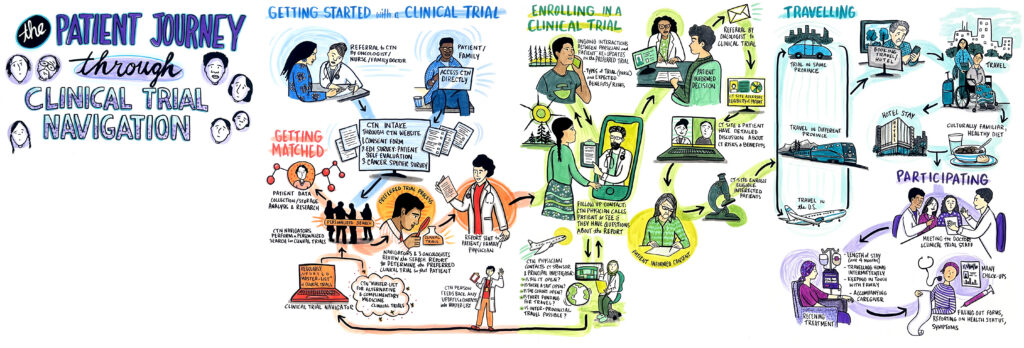
The process started with a large, hand-drawn infographic — created by Lynne Dalgleish of ThinkLink — mapping every stage of a patient's journey through clinical trial navigation, from first hearing about a trial through to travel, treatment, and follow-up. This wasn't an abstract diagram; it became the physical anchor for every conversation that followed, with participants literally posting ideas and concerns onto the infographic at the point in the journey where they applied.
Step Two: Barrier Identification, Grounded in Empathy
At the First Annual CTN Indigenous Meeting of Minds in Toronto (April 2025), participants began by building "empathy maps" — imagining, in detail, what a real or hypothetical Métis cancer patient might be seeing, hearing, thinking, feeling, and saying at each stage of their journey. From there, participants brainstormed barriers individually, then in small groups, sorting them onto the patient journey infographic.
What emerged were five clear barrier categories:
- Cultural safety and identity (e.g., lack of recognition of Métis identity, restrictions on traditional medicine)
- Communication and information (e.g., medical jargon, unclear consent processes)
- Systems and institutions (e.g., mistrust from colonial history, lack of data sovereignty)
- Logistics and practical concerns (e.g., travel, finances, eligibility for benefits)
- Psychosocial and relational dimensions (e.g., isolation, unresolved trauma)
Step Three: Solution Co-Creation
In the afternoon, the same participants rotated through a "Solutions World Café" — three twenty-minute rounds of conversation at stations representing different stages of the patient journey. Each round built on the ideas from the last, with participants generating concrete solutions rather than staying at the level of complaint or critique. This is where ideas like flexible intake options, Indigenous-specific space in clinical facilities, and a separate patient-reported outcomes survey for Métis patients were first put on paper.
This work didn't stop at the meeting itself. A follow-up online session in July 2025 brought together CTN staff, BC Cancer's Indigenous cultural safety experts, and Cancer Care Ontario Navigators to work through who could act on which solutions and how — turning ideas into assigned roles and next steps.
Step Four: Model Visualization
Finally, the many individual solutions were distilled into a single, coherent structure: the 8 Core Elements of the CTN Métis Pathway Program. Rather than leaving solutions as a long, disconnected list, the goal was a visual model that the whole team — and future partners — could look at and immediately understand how the pieces fit together.
Why This Process Matters
None of this was designed behind closed doors. Fourteen participants — CTN team members, Indigenous Patient Navigators from Ontario and Manitoba, a Métis patient representative, and cultural safety leads from British Columbia — spent a full day in the room together, and the process continued through follow-up sessions afterward. The result is a pathway that reflects what Indigenous patients, navigators, and community partners actually said they needed — not what looked good on paper from the outside.